01
A calmer operating system
Casa is built for landlords who want a calmer, more reliable way to run a property portfolio without losing track of the details that usually slip between spreadsheets, email threads, text messages, and shared drives. The platform brings the operational side of renting into one system so that requests, documents, tenancy records, schedules, and communications are not treated as separate jobs. For a landlord, that means less time reconstructing what happened and more time making decisions with the full context in front of them.
02
Clear for one property, consistent for many
For a single-property landlord, the value is clarity. You can see which tenant is active, which tasks are still open, and which documents need attention, without building your own workflow from separate tools. For a growing landlord, the value becomes consistency across multiple addresses. The same structure is repeated for every property, so you do not need a different process for each tenancy, each contractor conversation, or each maintenance issue. That consistency is what helps the system stay useful as the portfolio becomes busier.
03
Maintenance history that stays connected
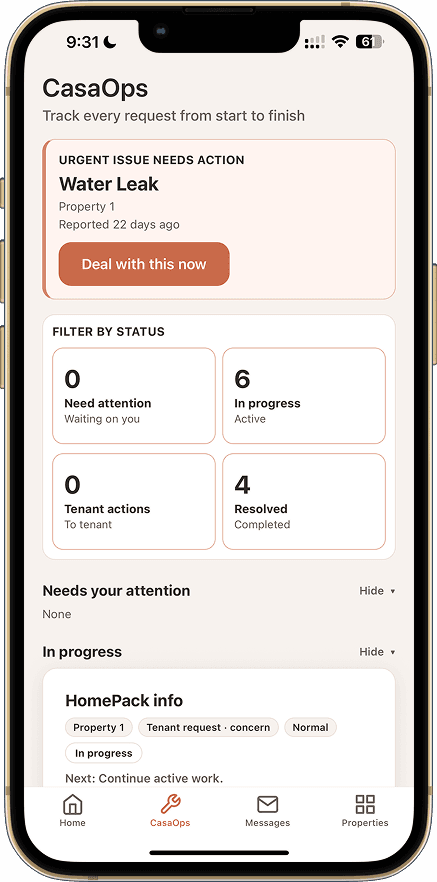
Maintenance is one of the clearest examples of why an integrated system matters. A repair request is rarely just one message. It usually involves a description of the issue, one or more replies, a decision about urgency, some form of scheduling, and later a record of what happened. Casa keeps that trail together, which reduces the chance of missed follow-ups, duplicate conversations, or confusion about whether a problem has already been acknowledged. The same history is then still available later if the issue returns or if a future tenant asks for context.
04
Documents around the property, not scattered across folders
Documents and compliance records need the same discipline. Landlords often store agreements, certificates, warranties, invoices, and reference material in different places depending on when they were created or who requested them. Casa groups those records around the property itself, which makes retrieval easier when a tenant needs something, when a renewal is due, or when you are checking the current status of a home before making a decision. Instead of searching old email threads, you are working from a property record that stays current over time.
05
Scheduling that supports proactive management
The scheduling layer matters because property management is not only about reacting to issues. It also includes inspections, reminders, appointments, notices, and recurring admin that need to happen at the right time. By linking those tasks to the same property context, Casa helps landlords see both the immediate work and the next actions that keep the portfolio running smoothly. That is especially useful when several properties are active at once and the risk is not one major failure but a series of small missed actions that create friction later.
06
A clearer experience for tenants as well
Tenants benefit from that structure as well. They get a clearer route for raising requests, following the conversation, and understanding what is happening next, rather than wondering whether a message has been seen or where to send the next update. That improves responsiveness without forcing the landlord into a heavier process. The result is a more practical relationship between landlord and tenant, because both sides are working inside a shared system with visible status, visible history, and a clearer next step.
 Casa
Casa